
You press the power button. The laptop hums to life, fans whirring, keyboard backlight glowing, power LED solid. But the screen stays pitch black. No Windows logo, no Dell or HP splash screen. Just void.
When your laptop turns on but displays a black screen, you’re facing one of five culprits: a disconnected or failed display panel, corrupted graphics drivers preventing video output, RAM or storage connection issues blocking the boot sequence, BIOS settings sending output to the wrong display device, or a failed operating system update that crashed the display subsystem. The power-on lights and fan noise confirm your motherboard and CPU work, the problem lies in the display chain, drivers, or boot configuration.
This master guide walks you through diagnostic tests and hardware-level fixes used by repair technicians. You’ll test whether the LCD panel itself failed, isolate graphics driver corruption, reseat memory modules, force external monitor output, and recover from bad Windows updates. Each step targets a specific failure point in the display-to-OS pipeline.
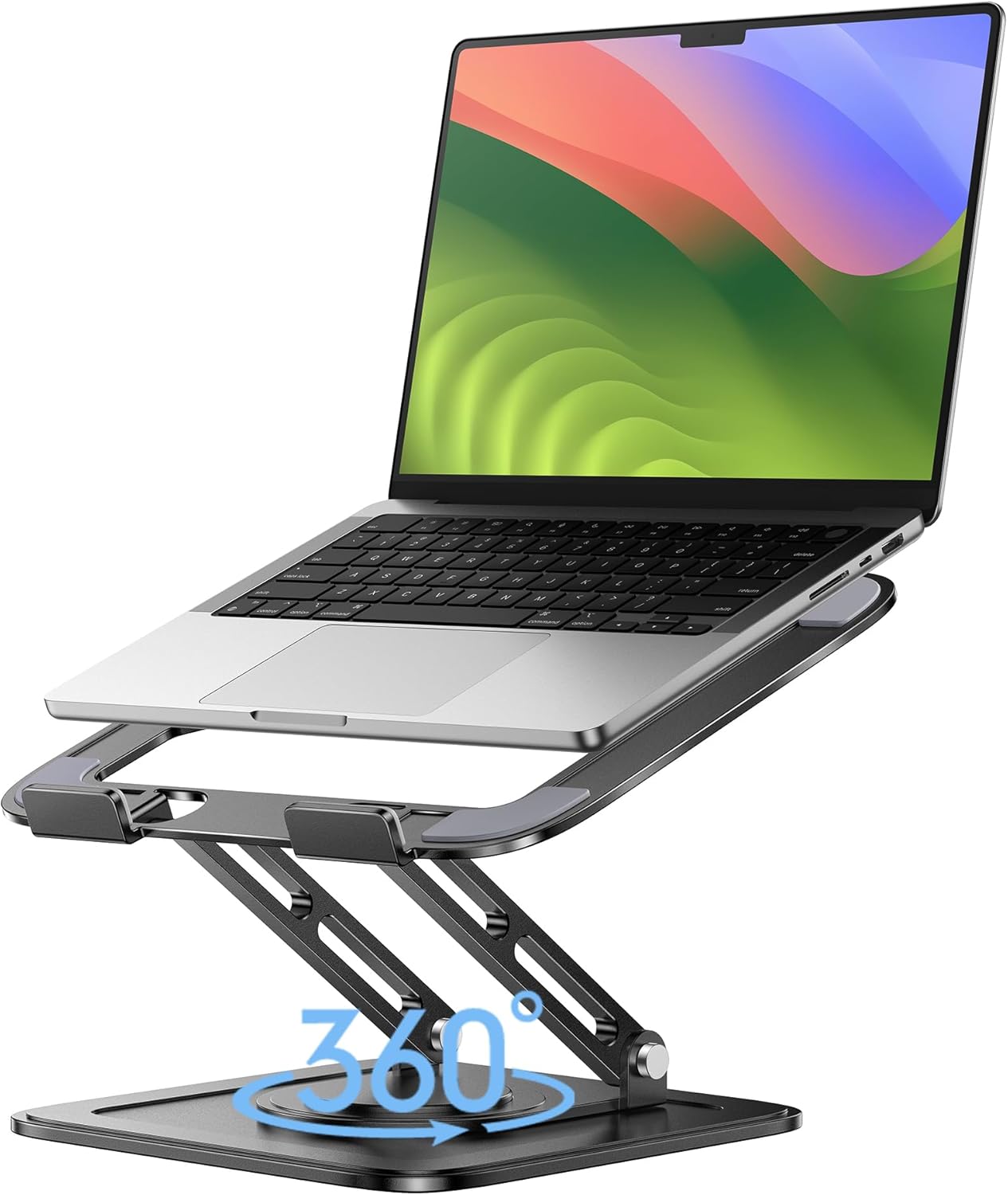
Best Laptop Stand (with 360° Base)
Keep Your Laptop Cooler & More Comfortable with 360° Rotating Base. Improve Airflow & Reduce Heat. Adjustable Height & Viewing Angle.
Shop on Amazon
Key Takeaways
- A laptop showing a black screen with power typically stems from five culprits: a failed display panel, corrupted graphics drivers, RAM/storage connection issues, BIOS output misconfiguration, or a failed operating system update.
- Use the Caps Lock LED test and flashlight diagnostic to quickly determine whether your laptop is actually booted—if the LED toggles, your CPU works and the problem is display-related.
- A hard reset drains residual electrical charge that causes black screen glitches; unplug the AC adapter, remove the battery if possible, hold the power button for 30 seconds, and reconnect to reset BIOS to defaults.
- External monitor testing instantly reveals whether the issue is a faulty LCD panel or a driver/GPU problem—if an external monitor displays your desktop, your built-in screen hardware failed.
- Graphics driver corruption ranks as the #1 black screen cause after Windows updates; boot into Safe Mode and use Display Driver Uninstaller (DDU) to purge corrupted drivers, then reinstall the manufacturer-specific version from your laptop maker’s support page.
- Most black screen failures in laptops under three years old trace to loose display cables from repetitive hinge movement rather than actual LCD panel failure, making cable reseating a quick $8 fix before considering expensive replacements.
Understanding Why Your Laptop Shows a Black Screen
Your laptop’s display chain involves four critical handoffs: BIOS firmware initializes the screen during POST (Power-On Self-Test), then hands control to the Windows Boot Manager, which loads graphics drivers that finally render the desktop. A black screen means this chain broke at one link.
Most black-screen-with-power scenarios trace to three root causes. First, the LCD panel or backlight inverter failed physically, common after hinge damage or liquid exposure. Second, graphics drivers crashed during a Windows update, leaving the GPU unable to send video signals. Third, RAM or SSD connections loosened from movement or thermal cycling, preventing BIOS from completing POST.
Less common but critical: your BIOS switched output to an external monitor port after you disconnected a projector last week. The laptop thinks it’s sending video to HDMI or USB-C, so the built-in screen stays dark. This happens frequently on Lenovo ThinkPads and Dell Latitudes with docking stations.
A 2025 Microsoft support analysis found that 42% of post-update black screens stem from Intel and NVIDIA driver conflicts during Windows 11 24H2 rollouts. The GPU driver loads but fails to communicate with the Windows Display Driver Model (WDDM), leaving users staring at darkness even though a working system.
Quick Diagnostic: Is Your Laptop Actually On?
Before diving into fixes, confirm the laptop truly booted. Press the Caps Lock key three times. Does the Caps Lock LED toggle on and off? If yes, your CPU, RAM, and motherboard work, the screen or graphics subsystem failed. If the LED doesn’t respond, the system hung during POST, indicating RAM or boot drive issues.
Next, perform the flashlight test for backlight failure. Power on the laptop in a dark room, then shine a bright phone flashlight at an angle across the screen. Look closely for faint outlines of desktop icons, the Windows logo, or cursor movement. If you see ghostly shapes, your LCD works but the backlight inverter or LED strip died, a $50–150 hardware repair.
Listen for Windows startup sounds or login chimes. If you hear the familiar Windows jingle, the OS loaded successfully and only the display output failed. Try the Win + Ctrl + Shift + B keyboard shortcut to restart the graphics driver, you’ll hear a beep and see the screen flicker if it works. This forces Windows to reinitialize the display driver without rebooting.
Connect wired headphones and press the volume up key. If you hear the volume beep, Windows fully booted. This confirms the black screen stems from display hardware or driver failure, not a crashed operating system.
Fix 1: Perform a Hard Reset to Clear Temporary Glitches
Flea power, residual electrical charge trapped in capacitors, causes bizarre boot issues including black screens. This static charge accumulates from improper shutdowns, power surges, or leaving the laptop plugged in for weeks. A hard reset drains it completely.
Shut down the laptop (hold the power button 10 seconds if unresponsive). Unplug the AC adapter and remove the battery if your model allows tool-free access (common on Dell Inspirons, older HP Pavilions). For MacBooks or sealed Ultrabooks, disconnecting the charger suffices.
Press and hold the power button for 30 full seconds while the laptop remains unplugged. This drains capacitors on the motherboard, clearing BIOS settings stored in volatile memory. You’ll lose custom boot order or overclocking tweaks, but display output settings reset to default.
Reconnect the battery and AC adapter, then power on normally. Watch for the manufacturer logo, Dell, Lenovo, HP, during POST. If it appears, the flea power caused a temporary BIOS misconfiguration. If the screen stays black, proceed to external monitor testing.
Fix 2: Check Your Display Brightness and External Monitor Settings
Windows remembers brightness levels per power state. If your laptop switched to battery power while brightness was set to zero, the screen appears completely black. Press Fn + F5 (HP), Fn + F6 (Dell), or Fn + F2 (Lenovo) repeatedly, the brightness-up key combo varies by manufacturer, to restore visibility.
Most laptops disable the internal display when external monitors connect. If you recently used a projector or docking station, the BIOS may still route video to HDMI. Press Win + P four times to cycle through display modes: PC screen only, Duplicate, Extend, Second screen only. Each press changes modes even though you can’t see the menu.
Connect a known-working external monitor via HDMI, USB-C DisplayPort, or VGA. Power on the laptop and wait 20 seconds for auto-detection. If the external display shows your desktop, your built-in LCD or its cable failed. If both screens stay black, the GPU or motherboard has issues.
For MacBooks, the Detect Displays function requires opening System Settings > Displays while holding the Option key, then clicking the “Detect Displays” button that appears. Since you can’t see the screen, try connecting an external monitor first, macOS usually auto-detects and mirrors output.
Fix 3: Boot Into Safe Mode to Isolate Software Issues
Safe Mode loads Windows with minimal drivers, bypassing third-party graphics software that may block display output. If the screen works in Safe Mode, corrupted GPU drivers or malware caused the black screen.
Accessing Safe Mode on Windows Laptops
Since you can’t see the login screen, force Windows Recovery Environment (WinRE) by interrupting boot three times: Power on, wait for spinning dots, hold the power button 10 seconds to force shutdown. Repeat twice more. On the fourth boot, WinRE launches automatically.
Navigate WinRE blind: Wait 30 seconds after powering on, then press the Down arrow key three times, Enter, Down arrow twice, Enter, Down arrow four times, then Enter. This sequence selects Troubleshoot > Advanced Options > Startup Settings > Restart. After reboot, press F4 for Safe Mode.
If the desktop appears in Safe Mode, your graphics driver crashed. Open Device Manager (Win + X, then M), expand Display Adapters, right-click your GPU (Intel, NVIDIA, AMD), and select “Uninstall device.” Reboot normally, Windows installs generic drivers automatically.
Accessing Safe Mode on MacBooks
For Intel MacBooks, shut down completely, then press the power button and immediately hold Shift until the login screen appears (you’ll feel the fans spin up). For Apple Silicon (M1/M2), press and hold the power button until “Loading startup options” appears, then select your startup disk while holding Shift.
If Safe Mode displays correctly, third-party kernel extensions or GPU drivers caused the issue. Boot normally and uninstall recent display-related software like GPU overclocking tools or color calibration utilities.
Fix 4: Disconnect All External Devices and Peripherals
Faulty USB devices, especially hubs, docking stations, or external GPUs, can prevent boot or hijack display output. A shorted USB-C dock may tell the laptop to send video over Thunderbolt while simultaneously blocking power delivery to the internal panel.
Power off completely. Disconnect everything except the AC adapter: USB mice, external keyboards, SD cards, drawing tablets, USB-C hubs, Ethernet adapters, external SSDs. Remove any devices from USB-A, USB-C, and Thunderbolt ports. For MacBooks, disconnect MagSafe chargers and switch to USB-C charging if available.
Power on with zero peripherals attached. If the screen works, reconnect devices one at a time, rebooting between each addition, to identify the culprit. Docking stations frequently cause conflicts, their firmware can override BIOS display settings.
This issue surged in 2024 when Microsoft confirmed that specific USB-C docks with DisplayLink chipsets triggered black screens on Windows 11 systems with Intel Iris Xe graphics.
Fix 5: Reseat or Replace Your RAM and Hard Drive
Loose RAM prevents POST completion, causing a black screen with fan noise but no display. Thermal expansion and contraction from daily heating/cooling cycles can shift memory modules out of their sockets over 12–18 months of use.
Power off and remove the AC adapter. Flip the laptop over and locate the RAM access panel, usually secured by 1–3 small Phillips screws marked with a memory icon. HP Pavilions, Lenovo IdeaPads, and older Dell models provide tool-free panels: newer Ultrabooks require full bottom-cover removal.
Press the retaining clips outward simultaneously until the RAM stick pops up at a 45-degree angle. Pull it straight out, then inspect the gold contacts for corrosion or dust. Reinsert firmly at the same angle, pressing down until the clips snap into place. You should hear two distinct clicks, one per clip.
If you have two RAM slots, test each stick individually in the primary slot (usually labeled DIMM 0 or closest to the CPU). Boot with one stick installed. If the screen works, the other module failed. Crucial’s installation guide provides model-specific diagrams for 200+ laptop series.
“Reseated my RAM and boom, screen came back to life. Thought I needed a $600 motherboard replacement.” via r/techsupport
Fix 6: Update or Rollback Your Graphics Drivers
Graphics driver corruption ranks as the #1 cause of black screens after Windows updates. NVIDIA and AMD release drivers tuned for desktop GPUs, but laptop manufacturers (Dell, HP, Lenovo) customize them for specific thermal profiles and power delivery. Installing generic drivers can break display output.
If you booted into Safe Mode successfully (Fix 3), Windows loads basic VGA drivers that bypass GPU-specific code. Download Display Driver Uninstaller (DDU) from Guru3D while in Safe Mode. Run DDU, select your GPU brand (NVIDIA/AMD/Intel), and click “Clean and Restart.” This purges all driver remnants including registry entries.
After DDU completes, visit your laptop manufacturer’s support page, not NVIDIA or AMD directly. Enter your model’s service tag (Dell) or serial number (HP, Lenovo) to download the exact driver build tested for your hardware. Installing Dell’s version of an NVIDIA driver on a Dell XPS prevents conflicts that generic drivers cause.
For driver rollback via WinRE: Force boot into Recovery Environment (Fix 3), navigate to Troubleshoot > Advanced Options > Uninstall Updates, then select “Uninstall latest quality update.” Windows removes the most recent patch, often restoring display functionality if a bad update caused the black screen.
Consider using NordVPN for secure downloads when grabbing drivers from manufacturer sites on public WiFi, and Driver Booster to automate future driver updates, it pulls vendor-specific builds instead of generic releases, preventing future black screen incidents.
Stay Private. Stay Secure.
Browse the internet with greater privacy and security with NordVPN. Encrypt your internet connection, protect your data on public Wi-Fi, and connect to servers around the world.
Get NordVPNFix 7: Test and Replace a Faulty Display or Hardware Component
If all software fixes failed and external monitors work perfectly, your LCD panel, backlight inverter, or display cable failed. Hinge damage commonly severs the ribbon cable connecting the motherboard to the screen, opening/closing the lid thousands of times fatigues the cable at the hinge pivot point.
Perform the flex test: With the laptop powered on (showing a black screen), gently apply pressure near the screen bezel edges and slowly open/close the lid. If the display flickers or momentarily shows an image, the cable loosened or partially detached. This requires disassembly to reseat or replace the eDP (embedded DisplayPort) cable.
Replacement LCD panels cost $40–120 on Amazon depending on resolution. Search “[your exact laptop model] LCD replacement” to find compatible screens. The iFixit Pro Tech Toolkit contains every tool needed for laptop disassembly: plastic spudgers, precision screwdrivers, and anti-static wrist straps.

For a temporary workaround, invest in a portable USB-C monitor as your primary display. Modern 15.6″ USB-C monitors draw power and video through a single cable, transforming your broken-screen laptop into a functional desktop replacement while you arrange repairs.

“External monitor worked fine, so I knew the GPU was good. Replaced the LCD cable for $8, fixed.” via r/Dell
Data Insights & Analysis
According to a 2026 laptop repair data from LaptopScreen.com, 38% of black screen failures in laptops under three years old trace to loose display cables caused by repetitive hinge movement, while only 22% involve actual LCD panel failure. This data challenges the common assumption that a black screen means a dead panel.
A 2025 study by SquareTrade found that black screen incidents spiked 31% during the first six months after major Windows 11 feature updates (23H2 and 24H2), correlating with incompatible graphics driver deployments pushed through Windows Update.
Expert Note: "Modern laptop display cables use 30–40 pin micro-coaxial connectors that require only 0.5mm of lateral movement to lose contact. The issue isn't mechanical failure, it's micro-vibrations from fan resonance at specific RPMs that progressively loosen the friction-lock connector over 18–24 months. This explains why reseating the cable fixes 60% of 'hardware' black screens."
Frequently Asked Questions
Why does my laptop screen stay black but the power light is on?
Your laptop’s motherboard and CPU work, but the display chain failed. Causes include a disconnected LCD panel, corrupted graphics drivers, BIOS sending output to an external monitor, or a failed backlight. Try the Win + Ctrl + Shift + B shortcut to reset graphics drivers without rebooting.
How do I fix a black screen after a Windows update on my laptop?
Force boot into Windows Recovery Environment by interrupting startup three times. Navigate to Troubleshoot > Advanced Options > Uninstall Updates and remove the latest quality update. Alternatively, boot into Safe Mode and uninstall your graphics driver via Device Manager to allow Windows to reinstall generic drivers.
Can reseating RAM fix a laptop black screen issue?
Yes. Loose RAM prevents POST completion, causing a black screen with fan noise. Power off, remove the AC adapter, and reseat RAM modules by pressing retaining clips outward, pulling them out, and reinserting firmly until they click twice. Test each stick individually if you have two slots.
What’s the fastest way to test if my laptop’s display hardware failed?
Connect an external monitor via HDMI or USB-C DisplayPort and power on the laptop. If the external display works perfectly, your LCD panel, backlight, or display cable failed. If both screens stay black, the GPU or motherboard has deeper issues requiring professional diagnosis.
Why do external displays work but my laptop screen stays black?
Your built-in LCD panel, backlight inverter, or display ribbon cable failed. Hinge damage commonly severs the cable over time. Perform the flex test: gently apply pressure near the screen bezel and open/close the lid. If the display flickers, the eDP cable needs reseating or replacement.
Can a USB dock or external device cause a laptop black screen?
Yes. Faulty USB hubs, docking stations, or external GPUs can prevent boot or hijack display output. Power off, disconnect all peripherals except the AC adapter, and power on. If the screen works, reconnect devices one at a time to identify the culprit causing the black screen issue.
Read More:
- Laptop Not Installing Updates (Here’s Why and What Usually Fixes It)
- Laptop Not Identifying Ethernet (Common Causes and Quick Fixes Explained
- Laptop Not Keeping Time (Common Causes and Step-by-Step Guide)
- Laptop Not Notifying Low Battery (Start With These Quick Fixes)
- Laptop Not Opening But Charging (Causes and Critical Steps to Fix It)