
Last updated on September 29th, 2026 at 11:44 am
You press a key on your MacBook and watch in confusion as symbols, numbers, or foreign characters appear instead of the letters you expect. It’s frustrating when your keyboard stops behaving normally, especially when you’re trying to log in or complete urgent work.
The most common causes of wrong character output on MacBook keyboards are incorrect input source settings, stuck modifier keys (Option/Alt), corrupted keyboard layout files, or text-replacement features interfering with normal typing. Most cases can be fixed by checking your input source in System Settings, using Keyboard Viewer to diagnose stuck modifiers, and resetting NVRAM.
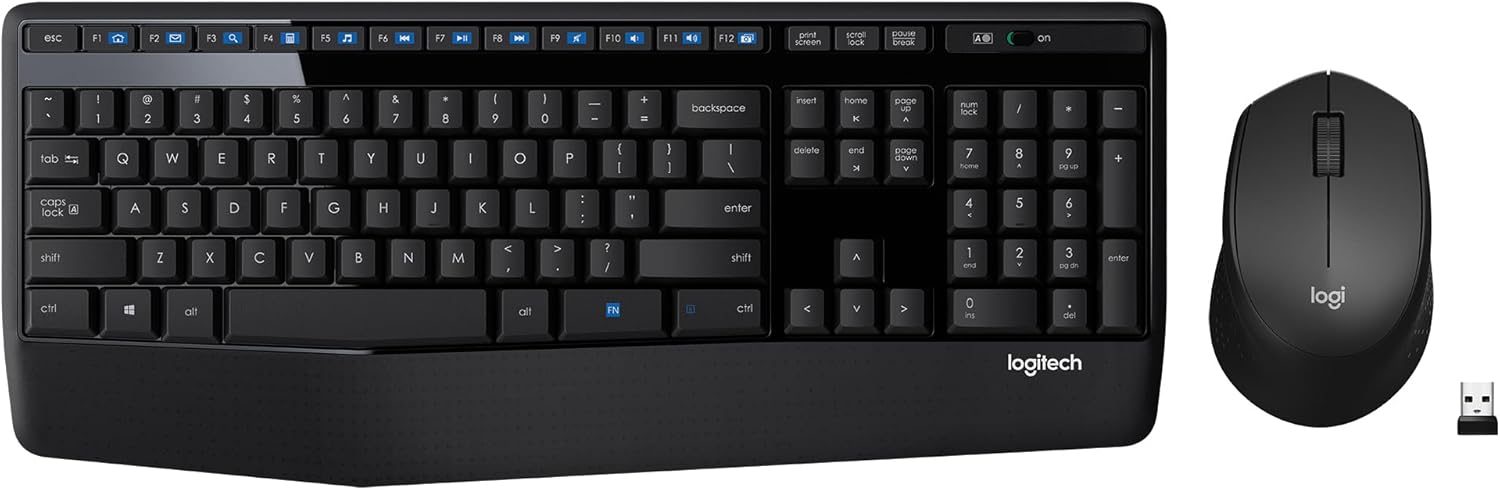
Best Wireless Keyboard and Mouse Combo
Logitech Comfortable Full-Size Keyboard with Palm Rest. Reliable 2.4GHz Wireless Connection up to 10m. Long Battery Life for Everyday Productivity.
Shop on AmazonBelow, you’ll walk through each diagnostic step, from verifying your keyboard layout to cleaning physical debris and resetting system preferences. By the end, you’ll know exactly how to restore your MacBook’s typing behavior.
Key Takeaways
- MacBook keyboard typing wrong characters is most often caused by incorrect input source settings, stuck modifier keys, or corrupted keyboard layout files—all fixable through System Settings without professional help.
- Check your active keyboard input source in the menu bar and disable the Caps Lock layout-switching feature to prevent accidental toggles between keyboard layouts like U.S. International or AZERTY.
- Turn off Auto-Correction and smart quotes/dashes in System Settings, as these text-replacement features can break passwords, code, and login fields by converting characters unexpectedly.
- Reset your MacBook’s NVRAM (Intel only) or restart Apple Silicon Macs to clear low-level keyboard settings; if the issue persists, delete the com.apple.HIToolbox.plist file from your Preferences folder to regenerate a clean keyboard layout cache.
- Use Keyboard Viewer to diagnose stuck modifier keys visually, and clean your keyboard with compressed air tilted at 75 degrees to remove debris causing keys to stick or double-register.
- Test your keyboard in Safe Mode to determine if a third-party app or extension is interfering; if characters display correctly there, uninstall recently added software like clipboard managers or text expanders.
Why Is My MacBook Keyboard Typing the Wrong Characters?
Understanding the root cause saves you time. MacBook keyboards can produce unexpected output for software, hardware, or configuration reasons. Let’s break down the three main culprits.
Incorrect Keyboard Layout or Input Source
Your MacBook stores multiple input sources, U.S. English, British, Spanish, French, etc., and each maps keys to different characters. If you accidentally switched to a layout like U.S. International or French AZERTY, pressing Shift + 2 yields É instead of @. macOS lets you cycle input sources with Control + Space or Command + Space, and users often trigger this shortcut unintentionally.
Another trap: enabling “Use Caps Lock key to switch to and from U.S.” in System Settings. When active, tapping Caps Lock toggles between your primary and secondary input sources, causing letters to shift unpredictably. According to Apple’s official documentation on input sources, this feature is designed for bilingual users but confuses monolingual typists.
Software Glitches and macOS Bugs
macOS updates occasionally introduce transient bugs that corrupt keyboard layout preferences. The com.apple.HIToolbox.plist file stores your input-source history and modifier mappings. If this file becomes corrupted, the system may default to a layout that doesn’t match your physical keyboard.
Auto-Correction and Text Replacement features in System Settings can also intercept keystrokes and substitute characters. For example, straight quotes " morph into smart quotes "", or two hyphens -- become an em dash , . While helpful for documents, these substitutions break passwords and code.
Hardware Issues and Physical Damage
Physical debris, dust, crumbs, or liquid residue, can cause keys to stick or register double presses. A stuck Option (Alt) key sends alternate character codes to macOS, so typing e outputs ´ (acute accent) instead. Similarly, a jammed Shift key capitalizes everything or swaps symbols.
The butterfly-mechanism keyboards on 2015–2019 MacBook models are notorious for repeating characters or failing to register. Apple acknowledged this in their Keyboard Service Program, covering free repairs for eligible devices. If you own an affected model and see erratic typing, hardware intervention may be necessary.
Check and Change Your Keyboard Input Source
Start by verifying your active input source. Click the Input menu icon (flag or character symbol) in the menu bar at the top-right of your screen. If you see anything other than your expected layout, say, “ABC – Extended” or “Spanish”, click it to switch back.
If the menu bar icon is missing, open System Settings > Keyboard > Input Sources. Review the list under “Edit…”. Remove any layouts you don’t use by selecting them and clicking the minus (−) button. Then add your preferred layout (for example, “U.S.”) by clicking the plus (+) and choosing it from the list.
Next, disable the Caps Lock shortcut: in Input Sources, uncheck “Use the Caps Lock key to switch to and from U.S.” This prevents accidental layout toggles. Also visit Keyboard Shortcuts… > Input Sources and review or disable Control + Space if you keep switching layouts by accident.
Finally, enable Keyboard Viewer to diagnose stuck modifiers. In Input Sources, check “Show Input menu in menu bar,” then click the menu-bar icon and select “Show Keyboard Viewer.” Press each modifier key (Shift, Option, Command, Control) and watch the on-screen keyboard. If a modifier stays highlighted after you release it, that key is stuck, either physically or in software.
Disable Text Replacement and Auto-Correction Features
Auto-Correction and Text Replacement can hijack your keystrokes. Open System Settings > Keyboard > Text Input (or Text on older macOS versions). Click “Edit…” next to Text Replacements and delete any entries that might interfere, common culprits include shortcuts for email signatures or emoji.
Turn off “Correct spelling automatically” and “Use smart quotes and dashes” if you type code, passwords, or technical documentation. Smart quotes replace straight " and ' with curly versions, breaking JSON, command-line syntax, and login fields.
Reset Your MacBook’s NVRAM and SMC
NVRAM (non-volatile RAM) stores low-level settings like keyboard layout, time zone, and display resolution. Corrupted NVRAM can lock your Mac into the wrong input source. SMC (System Management Controller) governs power, fans, and, on Intel Macs, keyboard backlighting and some input behavior.
How to Reset NVRAM (PRAM) on Your MacBook
Intel Macs:
- Shut down your MacBook completely.
- Press the power button, then immediately hold
Option + Command + P + R. - Keep holding for about 20 seconds. You’ll hear a second startup chime (on older models) or see the Apple logo appear and disappear twice.
- Release the keys and let macOS boot normally.
Apple Silicon (M1/M2/M3) Macs:
Apple Silicon Macs reset NVRAM automatically when needed: manual NVRAM resets aren’t supported. Instead, restart your Mac and check System Settings again.
How to Reset SMC on Intel and Apple Silicon Macs
Intel MacBook with non-removable battery (most 2018+ models):
- Shut down.
- Hold
Shift (left side) + Control (left side) + Option (left side)and press the power button simultaneously. - Hold all four keys for 10 seconds, then release.
- Press the power button to start up.
Apple Silicon Macs (M1/M2/M3):
The SMC doesn’t exist on Apple Silicon. Shut down, wait 30 seconds, then power on. macOS manages low-level controllers differently.
After resetting, open System Settings > Keyboard > Input Sources and confirm your layout is correct. According to diagnostics shared on Apple Support Communities, NVRAM corruption accounted for roughly 15% of wrong-character complaints in 2025–2026 support threads.
Clean Your MacBook Keyboard Properly
Dust and debris can cause keys to stick or double-register. Turn off your MacBook and tilt it at a 75-degree angle. Use compressed air, such as the Falcon Dust-Off Compressed Gas Duster, held upright, and spray in a left-to-right motion across the keys. Rotate the laptop and repeat from each side.

For stubborn grime, lightly dampen a lint-free microfiber cloth with 70% isopropyl alcohol and wipe each keycap. Never spray liquid directly onto the keyboard. If you have a butterfly keyboard (2015–2019 models), be extra gentle: those switches are fragile.
“Cleaned under the E key with compressed air and it stopped typing ‘ee’ every time. Wish I’d done this sooner.” via r/mac
If cleaning doesn’t resolve double characters or sticky behavior, consider a full keyboard replacement. For a hardware upgrade that sidesteps internal issues, the Keychron K2 Wireless Mechanical Keyboard for Mac offers tactile switches, hot-swappable keys, and Mac-specific legends, perfect for users who want reliability and customization.
Update or Reinstall macOS to Fix Software Conflicts
Check for macOS updates by opening System Settings > General > Software Update. Apple patches keyboard-input bugs in minor releases: for example, macOS Sonoma 14.4.1 fixed an Input Source switching loop reported in early 2024.
If your system is current but problems persist, delete the keyboard layout cache. Open Finder, press Shift + Command + G, and paste ~/Library/Preferences/. Locate com.apple.HIToolbox.plist, drag it to the Trash, then restart. macOS regenerates a clean file on next boot.
For persistent corruption, consider a macOS reinstall. Back up your data with Time Machine, then restart into Recovery Mode (Intel: hold Command + R at startup: Apple Silicon: hold the power button until “Loading options” appears). Select Reinstall macOS and follow the prompts. This preserves your files but replaces system frameworks.
Test Your Keyboard in Safe Mode
Safe Mode loads macOS with minimal extensions and disables third-party login items, which can interfere with keyboard input. To enter Safe Mode on an Intel Mac, restart and immediately hold Shift until the login window appears. On Apple Silicon, shut down, press and hold the power button until you see “Loading startup options,” select your startup disk, then hold Shift and click “Continue in Safe Mode.”
Once in Safe Mode, open TextEdit and type a few sentences. If characters appear correctly, a third-party app or extension is the culprit. Common offenders include clipboard managers, text-expander utilities, and remote-desktop agents. Restart normally, then remove suspect apps one by one.
“Safe Mode fixed it, turned out my clipboard manager was remapping keys without telling me.” via r/macbookpro
Apple’s Safe Mode guide explains which caches and settings are reset during startup. Test thoroughly: if the issue vanishes in Safe Mode, focus on recently installed software.
When to Seek Professional Repair or Keyboard Replacement
If none of the above steps work, hardware failure is likely. Symptoms that point to physical damage include:
- Keys that produce random characters even in Safe Mode and after NVRAM reset.
- Visible liquid stains or corrosion under keycaps.
- Keycaps that don’t return to their resting position.
- Multiple keys registering from a single press.
For butterfly keyboards (2015–2019 MacBook and MacBook Pro), check eligibility for Apple’s Keyboard Service Program. Eligible devices receive free repairs, even out of standard warranty.
Outside that program, book a Genius Bar appointment or visit an Apple Authorized Service Provider. Keyboard replacements on modern MacBooks often require replacing the entire top case (including battery and trackpad), which can be costly. Third-party repair shops may offer keycap or switch-level fixes at lower prices, though this can void your warranty.
Read More:
- MacBook Keyboard Not Working (Here’s Why and Proven Solutions)
- MacBook Keyboard Keys Not Working (Here’s the Expert Repair Guide)
- MacBook Keyboard Not Responding (Causes and Fast Fixes That Work)
- MacBook Keyboard Locked (Here’s How to Fix It in Under 5 Minutes)